The short answer
For a new project in 2026, start with Playwright. Genuine cross-browser support including WebKit, real parallelism for free, four language bindings, and no architectural restriction on tabs or origins.
If you already have a working Cypress suite, keep it. A maintained suite your team trusts is worth more than a migration that stalls at sixty percent. Migrate only when you hit a specific wall — Safari coverage, a cross-origin flow, a multi-tab journey, or a parallelisation bill.
Neither choice addresses the thing that actually kills E2E suites, which is the subject of the last third of this article. Pick either, then solve the real problem.
The architectural difference that explains everything else
Cypress runs your test code inside the browser, in the same event loop as your application. That gives it its famous debugging experience — you can inspect application state directly, because your test is right there next to it.
Playwright drives the browser from outside, over a debug protocol, the way a remote control drives a television. Your test is a separate process issuing commands.
Almost every practical difference between the two follows from that one decision. Cypress cannot easily handle a second tab because it lives inside the first one.
Side by side
Runs inside the browser, with the app
Drives the browser from outside
Chrome, Edge, Firefox, WebKit (limited)
Chromium, Firefox, WebKit — all first class
JavaScript / TypeScript
JS/TS, Python, Java, .NET
Historically via paid dashboard
Built in, free, across workers
Not supported by design
Supported
Workable but constrained
Native
Yes
Yes, with stricter actionability checks
Time-travel runner, very approachable
Trace viewer, codegen, inspector
Mature and well-liked
Available, less established
cy.intercept, ergonomic
Route interception, more capable
Where Cypress genuinely wins
- Debugging ergonomics. The time-travel runner, showing DOM state at every step, is still the most approachable debugging experience in E2E testing. Developers new to the discipline get productive faster.
- Component testing. More mature and more widely adopted than Playwright’s equivalent. If you want one tool for component and E2E, this is a real argument.
- Ecosystem familiarity. Years of Stack Overflow answers, plugins, and engineers who already know it. Underrated when hiring.
- Network stubbing feel.
cy.interceptis pleasant to write. Playwright’s routing is more capable and less immediately readable.
Where Playwright genuinely wins
- Real cross-browser coverage. WebKit is a first-class target, which matters because Safari is where layout bugs actually appear.
- Parallelism without a bill. Workers out of the box. On a suite of a hundred tests this is the difference between four minutes and twenty.
- Multiple tabs, windows and origins. OAuth flows, payment redirects and “open in new tab” journeys work without contortion.
- Language choice. Python, Java and .NET bindings mean the QA team can write tests in the language they already use.
- The trace viewer. A recorded timeline with DOM snapshots, network and console per step. Closes much of the debugging gap.
The same test, written three ways
A concrete comparison. One check: apply a coupon and verify the discount. First in Cypress:
cy.visit('/') cy.get('[data-testid="add-lamp-hd"]').click() cy.visit('/#/cart') cy.get('[data-testid="coupon-input"]').type('NORTH20') cy.get('[data-testid="apply-coupon"]').click() cy.get('[data-testid="discount"]').should('have.text', '-$8.80')
Then in Playwright:
await page.goto('/') await page.getByTestId('add-lamp-hd').click() await page.goto('/#/cart') await page.getByTestId('coupon-input').fill('NORTH20') await page.getByTestId('apply-coupon').click() await expect(page.getByTestId('discount')).toHaveText('-$8.80')
The two are nearly identical, which is the honest headline of most Playwright-versus-Cypress comparisons. Both are fine. Both also share a property worth noticing: every line references data-testid attributes that must exist in the markup and stay stable forever.
And the third way:
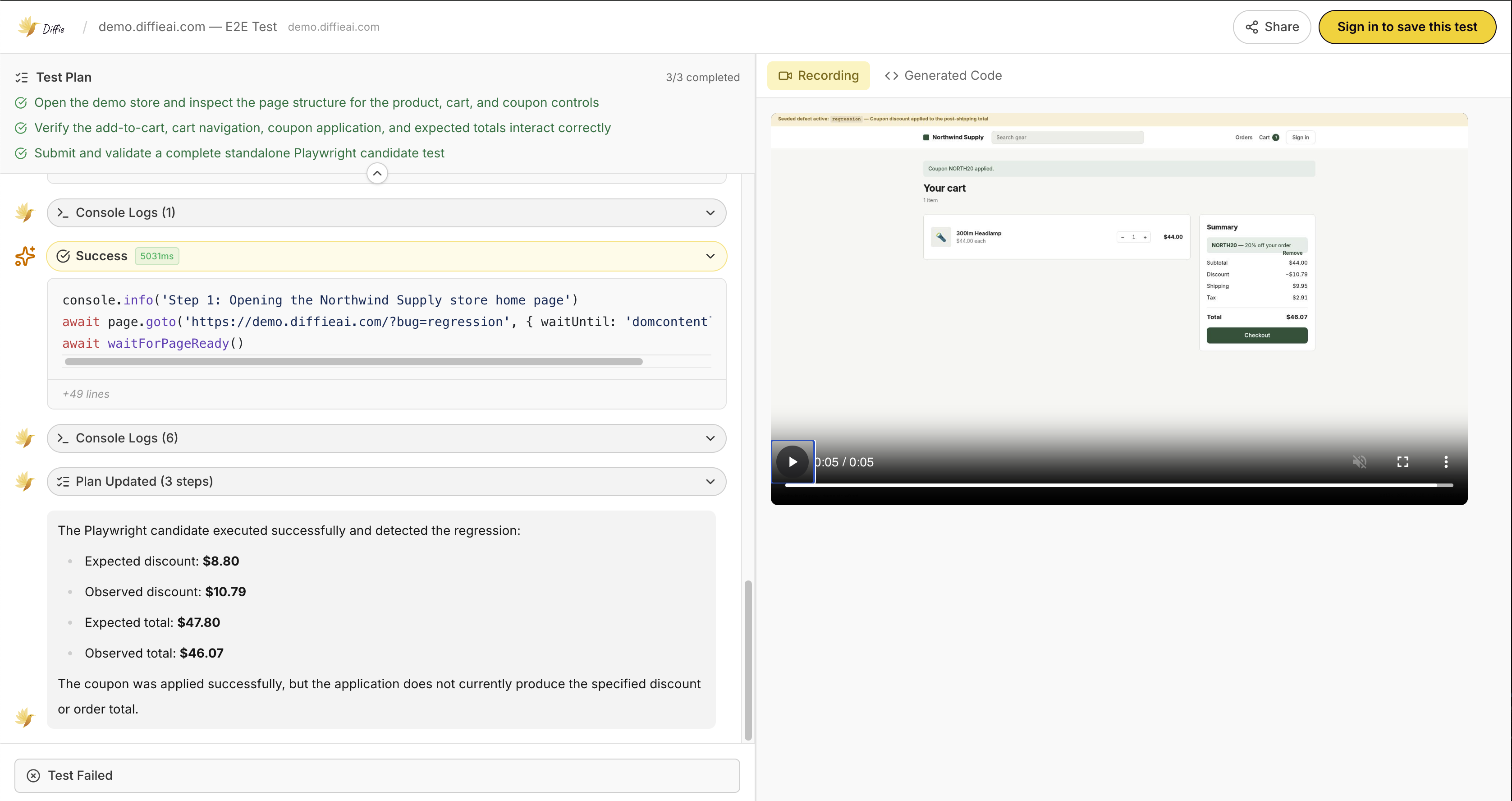
Add the 300lm Headlamp to the cart, open the cart, apply the coupon NORTH20, and verify the discount line shows $8.80.
1. Go to the store home page 2. Add the 300lm Headlamp to the cart 3. Open the cart 4. Enter the coupon code NORTH20 and apply it 5. Verify the discount line shows $8.80 and the order total is $47.80
Diffie explored the page, resolved the controls itself, wrote a standalone Playwright candidate, ran it, and reported expected $8.80, observed $10.79. The output is a Playwright file — the framework question and the authoring question turn out to be separable.
What neither framework fixes
Look again at those two code samples. Six lines each, and six references to markup. When somebody renames a test id, restructures the summary card, or wraps the discount in a new component for a design refresh, both tests fail — and neither failure indicates a bug.
Teams do not abandon E2E testing because they picked the wrong framework. They abandon it because the suite kept failing for reasons that were not bugs, until red stopped meaning anything.
Both frameworks have worked hard on this — auto-waiting, actionability checks, retry semantics, better locators. All of it helps with timing flakiness. None of it helps with structural flakiness, because a framework cannot know that the div you moved still represents the same thing to a customer.
The third option
There is a version of this decision where the framework becomes an implementation detail. If the test is written as a description of the journey — the way an acceptance criterion is written — then the selectors are generated rather than authored, and regenerated when the markup moves.
That is what Diffie does, and the output is a Playwright test. So the answer to “Playwright or Cypress” can reasonably be “Playwright, and I am not going to hand-write it”.
If you would rather compare directly, we keep honest pages for Diffie vs Playwright and Diffie vs Cypress, including where each framework is the better answer.
Frequently asked questions
Is Playwright better than Cypress?
For most new projects in 2026, Playwright is the stronger default — genuine cross-browser support, real parallelism in the free tier, multiple language bindings, and no architectural restriction on multiple tabs or origins. Cypress remains excellent for component testing and has a more approachable debugging experience for developers new to E2E.
What is the main architectural difference between Playwright and Cypress?
Cypress runs your test code inside the browser, alongside the application. Playwright drives the browser from outside over a debug protocol. That single decision explains most of the practical differences: multi-tab support, cross-origin handling, and which browsers each can genuinely automate.
Is Cypress faster than Playwright?
Generally no. Playwright parallelises across workers out of the box at no cost, while Cypress parallelisation historically depended on its paid dashboard. On a single spec the difference is small; across a suite of a hundred, Playwright usually finishes considerably sooner.
Can Playwright and Cypress test mobile?
Both emulate mobile viewports and touch. Neither drives a real physical device on its own — for genuine device coverage you need a device cloud or a platform that provides one.
Should I migrate from Cypress to Playwright?
Not for its own sake. Migrate if you are hitting specific Cypress limits — cross-origin flows, multi-tab journeys, Safari coverage, or parallelisation cost. A working Cypress suite that your team maintains is worth more than a half-finished Playwright one.
Do Playwright or Cypress reduce test maintenance?
Not fundamentally. Both are excellent at executing tests written against selectors, and both inherit the problem that selectors change for reasons unrelated to behaviour. The maintenance cost belongs to the approach, not to either framework.